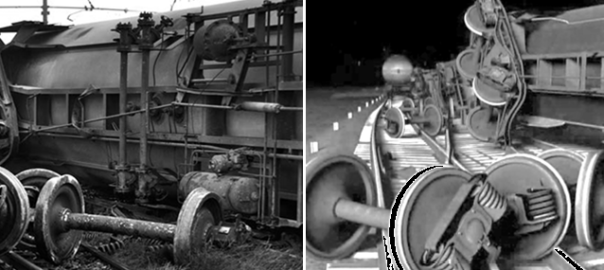

The Viareggio Railway Disaster. In Viareggio, Italy June 29, 2009 it was a quiet summer evening until a train derailed and a tanker carrying liquid petroleum gas (LPG) was ripped open creating a fire of huge proportions. Thirty-two people died. None of the victims were on the train, they were at home or walking along the street. The accident remains the worst disaster in the history of the Italian railway system in a time of peace.
This section describes how the Sequence of Events (SEA) method was applied using the technology of the 3D graphics as a support tool which led to the reconstruction of complex Accident.
The SEA applied to Viareggio Railway Disaster Accident Reconstruction
This reconstruction was developed during the execution of technical consultancy and on behalf of some families of the victims and the public entities appearing as plaintiffs in the criminal proceedings.


The material contained herein was presented on May 27, 2015 before the Court of Lucca in Criminal Trial “Proc . Pen . N. R. G. TRIB . 2135/13 - R.G.N.R. 6305/09” Sez . Pen . with President Boragine, Judge Marino and Judge Genovese.
Any reproduction and use is prohibited for purposes other than educational and informative about the forensic technique of Sequence Event Analysis assisted by 3D Graphic Animation
Chapter 1 – Reconstruction of static scene of accident: verifying dimension

Italian Version || English version
Chapter 2 – Locating evidence in 3D static scene and aerial reconnaissance by virtual drone
Italian Version || English version
Chapter 3 – Matching key-events with traces

Italian Version || English version
Chapter 4 – Viareggio accident event reconstruction by Sequence of Event Analysis (SEA) assisted by 3D graphic animation

Italian Version || English version
Chapter 5 -Importing kinematic data recorded onboard locomotive by Data Information System (DIS) into the 3D dynamic scene

Italian Version || English version
Chapter 6 – Verifying tank wagon n#1 movement as reconstructed in Chapter 4 between key-events «impact of axle box with rail track element» and «final position» by multi body analysis and real kinematics data recorded by onboard DIS

Italian Version || English version
Chapter 7 – Kinematics of cut production onto wagon car

 Forensic SEA